

How Data Is Transforming Italy’s Transport Infrastructure
The transport sector is undergoing a transformation that is reshaping the way roads and railways are monitored. Artificial intelligence makes it possible to predict infrastructure deterioration, reducing emergency interventions and improving safety and operational continuity. By 2030, the market for AI applied to transport is expected to exceed 10 billion dollars, driven by digitalisation and the growing use of sensors, predictive models and automated systems.
From Prevention to Prediction
Predictive maintenance anticipates failures and enables planned interventions through the analysis of large datasets. The result is a 25–30% reduction in costs and a 35–45% reduction in downtime.
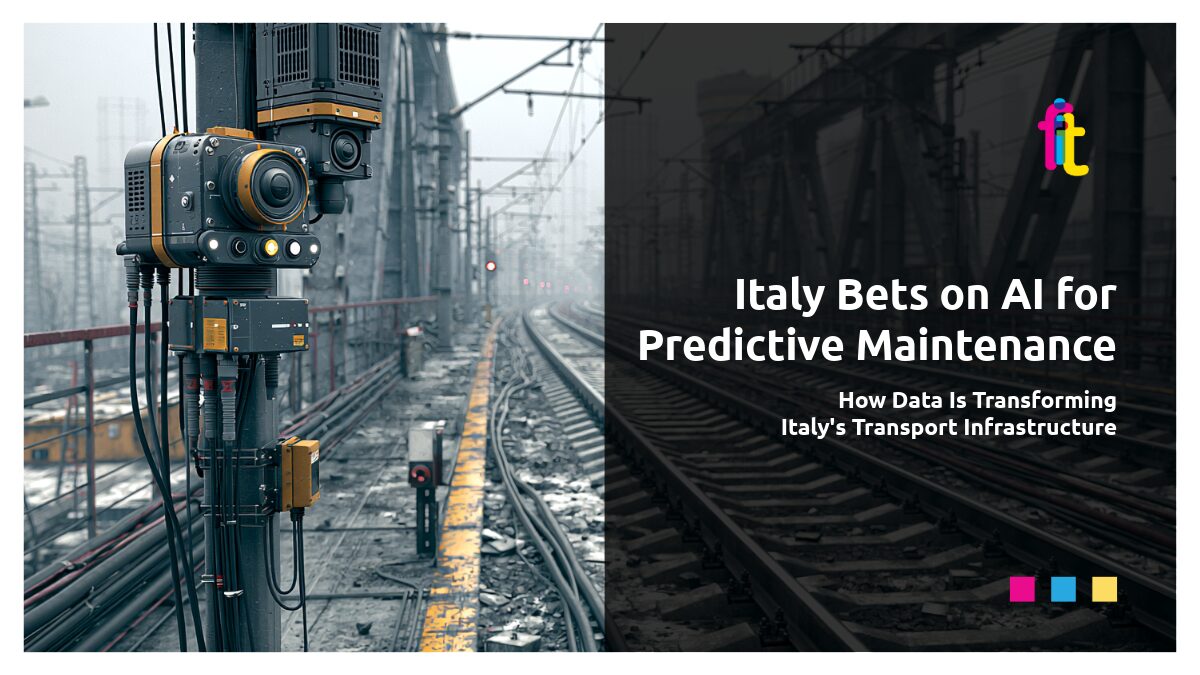
In the railway sector, RFI — managing 17,000 km of lines and 9,000 trains per day — has embedded this approach in its Strategic Plan 2025–2029. IoT sensors installed on rolling stock continuously analyse track geometry, while neural networks detect anomalies before they turn into safety issues.
In road transport, AI-based systems identify and classify pavement deterioration. The Argo Project by Movyon, developed with Autostrade per l’Italia, monitors more than 4,000 engineering structures using drones, sensors and 3D models, generating digital twins that allow remote inspections with high precision.
Anas has activated a national Structural Health Monitoring programme, financed through the PNRR, to monitor bridges and viaducts using predictive models and distributed sensor networks.
Integrated Technologies and New Skills
The strength of predictive maintenance lies in integrating algorithms, geo-referenced data, high-resolution imaging and multi-criteria analysis. Risk-prediction systems enable infrastructure managers to optimise limited resources and focus on the most critical areas, contributing to fewer accidents and improved safety.
This transition requires multidisciplinary skills: engineering, data science, infrastructure management and governance capable of aligning public and private actors. Italy is consolidating these capabilities thanks to the work of RFI, Anas, Movyon and the main infrastructure operators, creating a model that can be scaled nationally.
AI applied to predictive maintenance is a new form of asset management that allows Italy to build transport infrastructure that is safer, more efficient and better prepared for the challenges ahead.