
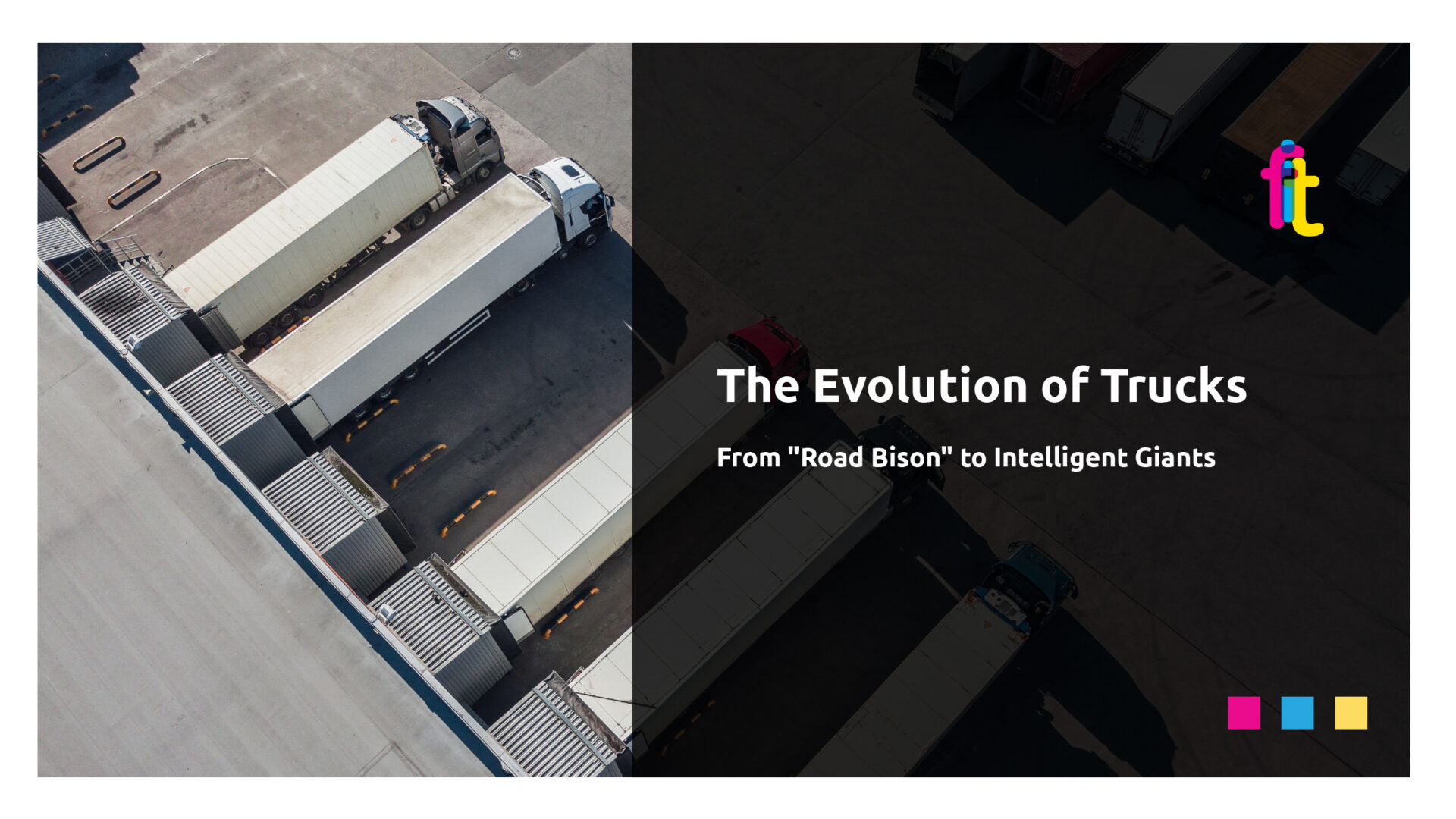
From “Road Bison” to Intelligent Giants
The road freight transport industry is experiencing an unprecedented transformation. This is not just about larger or more powerful vehicles, but a revolution that touches safety, sustainability, and artificial intelligence. A metamorphosis capable of transforming traditional “road bison” into advanced technological platforms, able to communicate with their surrounding environment and redefine the entire logistics ecosystem.
Change is already underway, and the numbers confirm it: serious accidents involving heavy vehicles in Italy have dropped by 12% over the past five years, reaching 2,100 in 2024. A result that goes beyond statistics and reflects the concrete impact of new technologies on road safety.
When Technology Meets the Road
European Regulation 2019/2144, which came into force in 2021, marked a turning point. The mandatory installation of Advanced Driver Assistance Systems (ADAS) on new commercial vehicles has triggered what Stefano Iacuzzi from MAN Truck & Bus Italia defines as “a silent but powerful revolution.”
The numbers speak clearly: Blind Spot Detection can monitor up to 5 meters in front of the vehicle, 4.5 meters laterally, and 20 meters at the rear. Radar systems and cameras allow “seeing” up to 80 meters behind the vehicle, anticipating braking and collisions. But the real innovation is integration: these are no longer isolated systems, but components of an intelligent platform that transforms the truck into an active node in the transport network.
The challenge, however, remains diffusion. In Italy, over 650,000 trucks are more than 15 years old and often lack any advanced systems. A situation that creates “two speeds” in the sector, with implications for both safety and business competitiveness.
The Poste Italiane Case: From Last Mile to Future
While the industry discusses emerging technologies, some Italian companies are already experimenting with concrete solutions. Poste Italiane has issued a 600,000 euro tender to develop an autonomous vehicle dedicated to last-kilometer distribution, within the framework of Mission 4 of the PNRR.
The project, lasting twelve months, represents more than a technological experiment. It is proof that innovation in transport can arise from the integration between specific operational needs and advanced design capabilities. The choice to develop the solution internally, rather than purchase already available technologies, reflects a long-term strategy oriented toward customizing logistics solutions.
Poste’s initiative fits into a broader strategy that also includes the installation of 10,000 automatic lockers for delivery, developed through the joint venture with DHL eCommerce. A systemic approach that combines vehicle automation and intelligent infrastructure for the last mile.
Beyond Autonomy: Toward an Integrated Ecosystem
Autonomous driving represents only one dimension of the ongoing transformation. As Iacuzzi emphasizes, “the real revolution is not technical, it’s cultural.” Innovation must be shared by the entire supply chain: designers, drivers, companies, local authorities.
This systemic perspective also emerges from German experiments, where the first autonomous driving tests for freight transport promise emission reductions of up to 15% thanks to driving style optimization. A result that derives not only from technology, but from its integration with broader operational strategies.
Artificial intelligence thus becomes the “invisible engine” of logistics. Connected fleets communicate with each other, predicting delays, optimizing loads, avoiding accidents, and saving fuel. Logistics centers operate powered by real-time data, making transport safer, more efficient, and sustainable.
Ecological and Technological Transition
The evolution toward more intelligent vehicles proceeds parallel to the energy transition. MAN announces the arrival of the first hydrogen trucks for 2026, while electrification consolidates for specific segments like urban distribution.
But the challenge is not only technological. The shortage of professional drivers in Italy exceeds 20,000 units, a criticality that automation could help solve through the transformation of professional profiles rather than their replacement.
As highlighted by Poste Italiane’s experience, innovation requires targeted investments and real-scale experimentation. The autonomous vehicle project for the last mile is not just a technological test, but a laboratory to understand how to integrate new solutions into consolidated operational processes.
Toward a New Logistics Paradigm
The transformation of road freight transport goes beyond the adoption of individual technologies. It represents the emergence of a new paradigm in which vehicles, infrastructure, and operational processes integrate to create systemic value.
The Italian experience, from Poste Italiane’s experiments to automotive industry developments, demonstrates that the country has the skills to play a leading role in this transition. Success will depend on the ability to coordinate technological innovation, infrastructure investments, and the evolution of business models.
Tomorrow’s “road bison” will be intelligent platforms that actively contribute to the safety, efficiency, and sustainability of freight transport. The evolution has begun and is accelerating: those who can best interpret it will determine the future of European logistics.
The transformation of road freight transport integrates safety, sustainability, and artificial intelligence. From mandatory ADAS to Poste Italiane’s autonomous driving experiments, Italy demonstrates having the skills to guide this evolution toward a new logistics paradigm.
Sources:
https://motori.ilmessaggero.it/commerciali/sicuri_intelligenti_sostenibili_i_nuovi_camion_cambieranno_il_mondo_del_trasporto-8910243.html
https://www.trasportoeuropa.it/notizie/tecnica-veicoli/poste-sperimentera-un-camion-a-guida-autonoma