

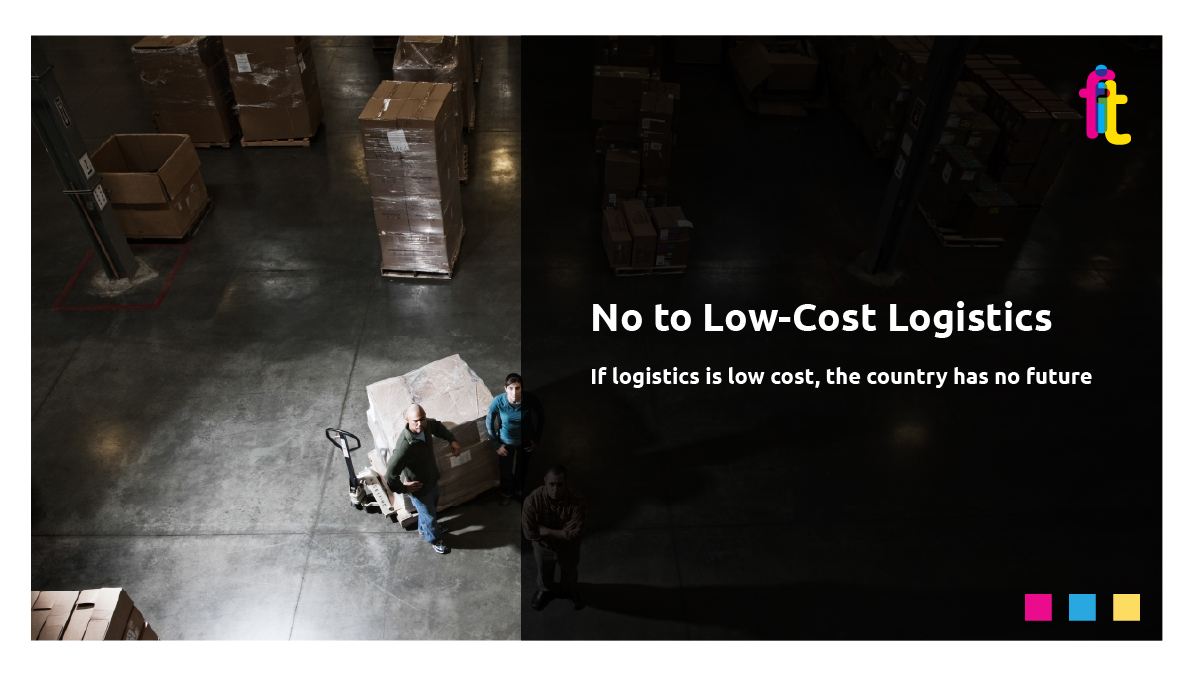
Low-Cost Logistics as a Threat to Made in Italy
Low-cost logistics is a death sentence for Made in Italy. A production chain that races to the bottom becomes fragile, unable to guarantee continuity, value and competitiveness. This way, our flagship products end up traveling through weak logistics chains, losing clout on international markets and letting others, often with interests at odds with our own, control the interface with sales channels. If we do not break this spiral, the risk is not only economic. It is political, social, cultural. Because without quality logistics, Made in Italy has no future. And without Made in Italy, Italy has no future.
In this lazy and, in some ways, contentious month of August, in which even the much-anticipated Alaska summit produced a mouse, an article of mine kindly published in Uomini e Trasporti sparked an interesting debate among several key sector stakeholders. My provocation rests on a basic premise: the quality of logistics supply depends on the quality of demand. In other words, logistics entrepreneurs cannot deliver an offer that is innovative, safe and sustainable unless the contracting side, public and private, is willing to recognize its value. Nor does it make sense to say entrepreneurs must manage to charge the right rate if the alternative is to park their trucks and let other “colleagues,” unscrupulous and light on ethics, step in to satisfy demand that is built on the pursuit of “low-cost logistics.” Chasing the lowest price yields an apparent saving in the short term, but over the long term it weakens the entire system. It erodes safety, investment and innovation, pushing honest companies to the margins. Behind the excellence of Made in Italy a growing risk is lurking. The same mechanism now undermining the credibility of fashion, rocked by investigations into subcontractors producing at off-market costs without respecting rules and rights, is seeping into logistics too. The rush to low cost in transport and distribution services is turning logistics into a mere cost to be squeezed, rather than a strategic driver of competitiveness. Yet a supply chain that does not invest in quality, innovation, sustainability and safety cannot sustain the value of Made in Italy. It hollows it out, makes it fragile and exposes it to the same accusations of opacity and exploitation that today shake the manufacturing of major brands. There is, however, a further and even more strategic risk. If we keep selling ex works, delivering goods to the first intermediary, we let others control the transport to the end customer. That way, direct contact with the commercial and sales channel no longer remains in our companies’ hands, but passes to third parties whose interests may diverge from promoting Made in Italy. Only a destination-delivered approach, where the Italian producer governs delivery all the way to the foreign customer, ensures commercial presence and brand valorization. If shippers and clients do not change tack, nurturing high-value services, our production system risks seeing what makes it unique evaporate, namely the ability to combine beauty, quality and reliability. Low-cost logistics is not an opportunity. It is the Achilles’ heel that can doom Made in Italy.
The Crucial Role of Demand and Quality-Driven Procurement
Hence my call for a supply chain based on legality, transparency and quality, for a rethinking of public incentives that today fail to distinguish between those who work well and those who do not, and for stronger associative capacity to overcome fragmentation and dependencies. The challenge is no longer only economic, but cultural and strategic. We must decide whether to support a competitive and sustainable model, or resign ourselves to marginalization.
This article subsequently prompted a series of contributions that I summarise below (and I apologise in advance to the authors for any excessive simplification of the concepts for the sake of brevity), each accompanied by a brief comment of mine that does not purport to be exhaustive but simply aims to offer an additional contribution to the debate, which I hope will soon find a broader forum capable of bringing the leading figures in the sector into dialogue with those who purchase low cost services.
Natalino Mori (Transadriatico) shares the criticism of fragmentation among associations and the lack of legality, but notes that institutional forums already exist, such as the Albo degli Autotrasportatori, where these issues can be brought together. He proposes enhancing existing tools (Code of Practice, ESG criteria) and emphasizes the responsibility of the GDO and the contracting side, too often left out of accident investigations. He is skeptical about scattergun incentives, while distinguishing them from excise duty refunds.
I broadly agree that institutions exist and should be strengthened, particularly the Albo, which I see at the moment as rather absent on matters of fundamental interest to the sector, with all the affection and esteem I have for its President. Yet no formal forum will produce change without tackling the demand side. If clients keep choosing low-cost services only, even the best intentions and most ambitious certifications risk remaining formalities. A real step up will be possible only if clients, associations and operators share responsibilities and rules, translating principles into concrete behavior. Without this balance, healthy firms will continue to be pushed to the sidelines.
Alessandro Peron (FIAP) urges us to escape the “trap of chronic complaining” and calls on entrepreneurs to take responsibility. They are the ones who choose whether to accept cut-rate conditions or invest in quality. He cites the TCR Observatory, developed with you as well, as an example for introducing reliability criteria beyond price.
I agree with the call for concrete action, but I repeat that the entrepreneur alone cannot reverse market dynamics warped by demand. Without clients who recognize the value of quality and legality, even virtuous entrepreneurs risk being excluded when services are selected on price alone. The provocation about “real entrepreneurs” is useful, but not enough. We need a supply-chain vision. Not isolated heroes, but a system in which responsibilities and rules are shared among those who produce, those who transport and those who buy.
Claudio Donati (Assotir) denounces the concentration of contracts in the hands of a few large players without their own assets, who subcontract more than 90 percent of turnover. He proposes introducing in Italy the principle of “proportionality” between vehicles or staff and turnover to limit subcontracting, following the French model. He also criticizes conflicts of interest in representative bodies.
Here too, I agree that the imbalance between those who hold contracts and those who actually transport is one of the main causes of the sector’s crisis. Proportionality would be a step forward, but it would not solve the core problem. If demand continues to prioritize low-cost service only, subcontracting will always find new channels. Representation is a critical issue, but the behavior of the contracting side matters even more. If large companies keep seeking mere executors, carriers will remain subcontractors without autonomy.
Pietro Spirito (Universitas Mercatorum) reads the logistics crisis as systemic. Delays, contractual imbalances and lack of regulation cost Italy billions in exports. He identifies as priorities an industrial policy for logistics, with contractual regulation, observatories, a national authority, support for intermodality and training, to make the sector more competitive and sustainable.
I fully share the need for an industrial policy. Logistics is an integral part of the country’s competitiveness. But without rebalancing demand and supply, no reform will be effective. A demand side that keeps imposing unsustainable conditions will neutralize any regulatory tool. Logistics is not a cost to be squeezed, a simple commodity. It is an extraordinary strategic asset for those who understand its potential. The competitiveness of Made in Italy also depends on the ability to distribute excellence through safe, traceable and transparent chains.
Umberto Ruggerone (Assologistica) calls for modern, fit-for-purpose rules and highlights initiatives already launched by Assologistica (Civil Code, the pallet law, reverse charge, Cruscotto). He emphasizes dialogue with the contracting side so logistics is perceived as a driver of competitiveness rather than a cost. He stresses the urgency of managerial training, associative cohesion and certifications that reward compliance.
Updating the rules is clearly necessary and fully sensible, but the real turning point will come when clients accept that logistics deserves recognition as part of industrial strategy. Dialogue with Confindustria and Federdistribuzione matters, yet we still have not seen concrete commitments on the demand side. Training and associative cohesion are fundamental levers. Without qualified human capital and a united front, the sector will remain weak. The necessary condition, however, remains the same. We need responsible demand to steer a sustainable supply, not an obsessive hunt for low-cost services.
The latest contribution, in chronological order, is from Donatella Rampinelli (manager and trainer), who underscores Italy’s specific features, namely fragmentation, complex geography and the prevalent use of ex works, which have fostered intermediation and lowball tenders. She points to collaboration and shared logistics as the only way to cut costs and create value, but decries the lack of mutual trust. Training is central. There are positive experiences in ITS and master’s programmes, yet companies often fail to retain trained young people. She concludes by urging a focus on skills and quality, with no self-pity.
On collaboration, I am completely aligned. For years we have been insisting on the need to build virtuous ecosystems as the solution to overcome fragmentation and mistrust. I remain convinced that without collaborative logistics we will never achieve economies of scale or competitiveness. Yet that collaboration must also include the contracting side, which today fuels cut-price tenders to buy low-cost services instead of building long-term relationships. Training is an investment we can no longer afford to waste. If the sector does not hire and value the young people we prepare, it means there is a lack of demand capable of recognizing the value of skills. And without qualified human capital, Italian logistics will remain trapped.
Towards a Competitive Model Based on Legality, Collaboration, and Skills
The debate that has emerged in recent weeks has had the merit of bringing to light structural knots that have long weighed on Italian logistics. Not only the race to cut prices, but also the lack of real dialogue between clients and operators, fragmentation among associations and low appetite for investment in skills and innovation. It is clear that simple fixes or top-down rules will not suffice. We need a cultural shift that begins with the contracting side and involves the more structured operators, including those who in turn purchase services through subcontracting. The hope is that this discussion will not end among insiders, but will become a shared opportunity for growth with shippers, distributors and all those who, by choosing a sustainable, quality model of logistics, can guarantee a future and competitiveness for Made in Italy on global markets.
No to low-cost logistics. If logistics is low cost, the country’s future becomes low cost too.