

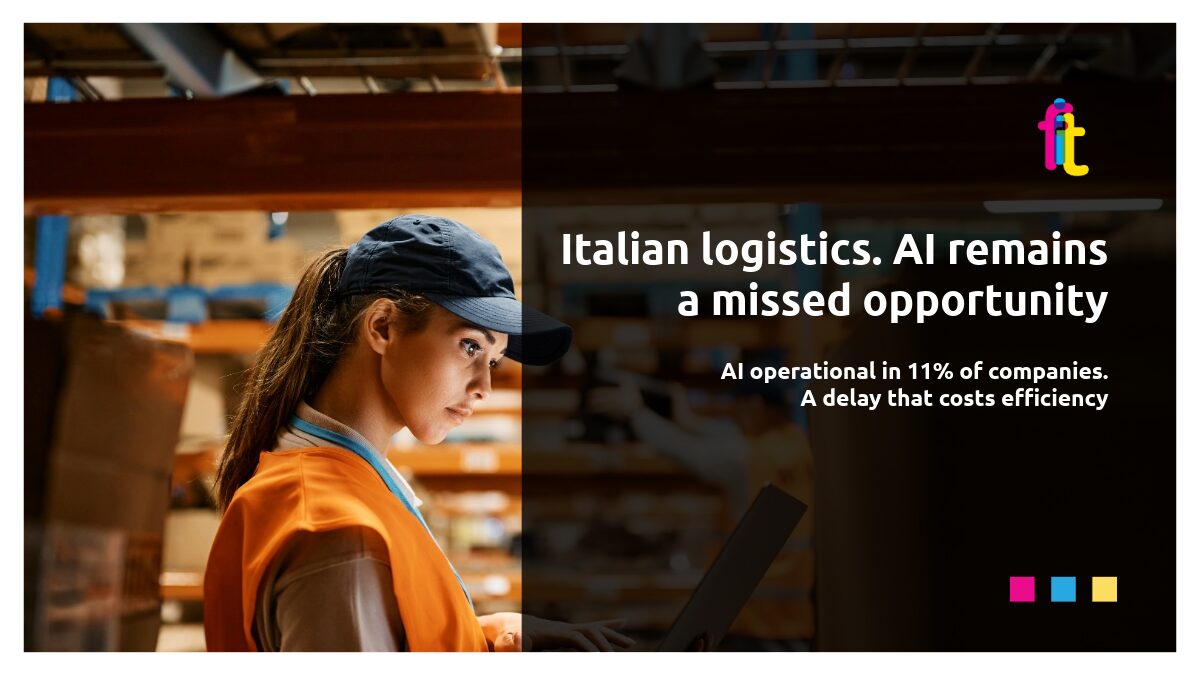
AI operational in 11% of companies. A delay that costs efficiency
The digital transformation in Italian logistics is proceeding slowly.
According to a report in Il T Quotidiano on February 13, 2026, 70% of companies still use Excel for logistics management and 75% lack a true, in-depth, structured digital transition.
Even more significant is the data on artificial intelligence: only 11% of companies have given it an operational role.
The picture emerged during a meeting promoted by Confindustria Trento dedicated to the role of artificial intelligence in business logistics.
In a context marked by geopolitical instability and the effects of the pandemic, supply chain management requires tools capable of anticipating critical issues and changes in demand.
This is where the concept of predictive artificial intelligence comes in: systems capable of analyzing data in real time to predict problems and anticipate market demands.

From reactive management to proactive management
According to the findings of the comparison, predictive AI enables a change in approach: from a passive logic, geared towards solving problems as they arise, to a management style capable of anticipating and planning.
This shift is particularly relevant in a sector characterized by high demand volatility, one of the main challenges for transport and logistics companies.
Factors such as reduced lead times, cost containment, and lower carbon dioxide emissions are cited as concrete effects of the adoption of artificial intelligence in logistics.
Innovation, therefore, while improving operational efficiency on the one hand, also has an impact on environmental objectives on the other.
Environmental pressure and transparency requirements
The latest industry data shows that the transport sector is currently responsible for 25% of total emissions in the European Union, with road transport accounting for over 70% of the sector’s emissions.
In this scenario, the Corporate Sustainability Reporting Directive requires greater transparency on emissions and impacts along the supply chain, transforming sustainability into a measurable and verifiable parameter.
For transport companies, this means that digitalization is moving from being a possibility to a technological choice, thanks in part to conditions that continue to ensure traceability, control, and regulatory compliance.
Artificial intelligence, applied in a targeted manner, can support this process by offering analysis and forecasting tools capable of improving the quality of decisions.

The current gap between technological potential and actual adoption therefore represents a strategic issue for the sector.
For logistics managers, understanding this transition means asking themselves not only which tools to adopt, but also what organizational model is needed to move from spreadsheet-based management to systems capable of reading the market and reacting with greater clarity.
Source: l T Quotidiano, “Intelligenza artificiale e logistica: solo l’11% delle aziende le attribuisce un ruolo operativo”, 13 febbraio 2026