

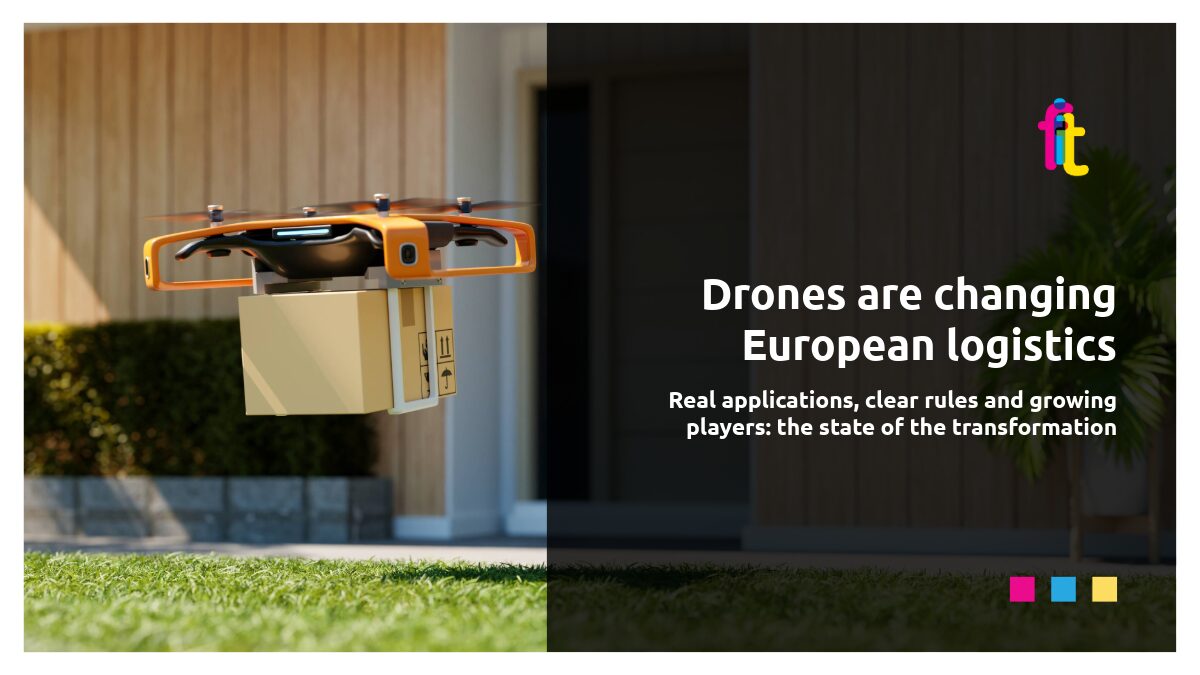
Real applications, clear rules and growing players
European logistics is changing fast, driven by drones. From experimental technology to operational tool, unmanned aerial vehicles are becoming an integral part of urban and industrial strategies across the continent. A shift made possible by technical advances and the new regulatory framework introduced by the European Union Aviation Safety Agency (EASA).
Recent projects have demonstrated that drones can reduce delivery times and costs while making transport more sustainable. In healthcare, they are already being used to deliver urgent medicines and biological samples between hospitals, as in the case of Wing, which has launched medical deliveries between two London hospitals, and Helicus, which conducts experimental flights between healthcare facilities as part of the SESAR SAFIR-Ready project. In ports and industrial areas, such as the Port of Antwerp, drones transport petrochemical samples, reducing turnaround times and emissions compared to conventional transport. In the consumer sector, Manna has conducted over 165,000 flights in Ireland delivering food and other goods, while Amazon is currently testing deliveries in Italy.
The EU regulatory framework has defined three operational categories (Open, Specific and Certified), establishing safety requirements and operational conditions. This is the framework that allows drone logistics to move beyond isolated tests and integrate into broader supply chain systems.
Challenges remain: ensuring airspace safety, developing digital infrastructure for drone traffic management and building trust among local communities. European logistics is already transforming, with faster, more sustainable deliveries increasingly matched to the real needs of cities, as demonstrated by the growing investments of major players such as Amazon alongside European start-ups like Dronamics, Helicus and Wing.