

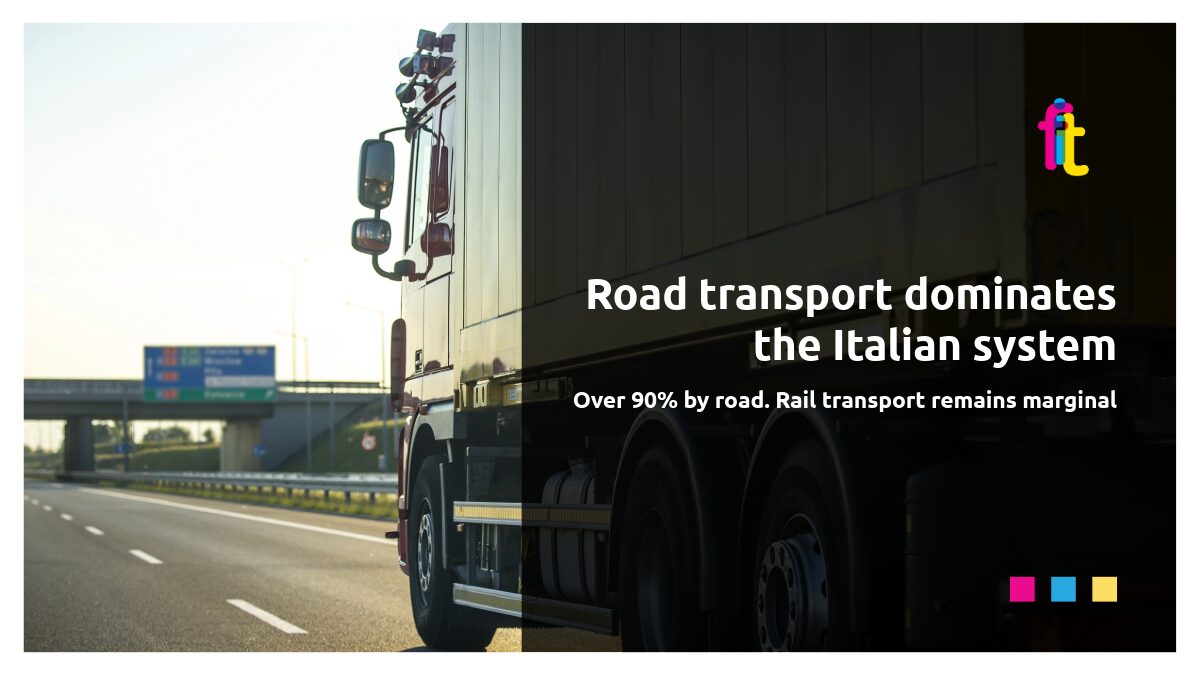
Over 90% by road. Rail transport remains marginal
In Italy, land freight transport continues to be dominated by road transport. In 2024, a total of 1,205.1 million tons were transported, with 92.1% traveling by road and 7.9% by rail. Even when looking at tons per kilometre travelled, road transport remains clearly dominant, accounting for 86.9% of total transport.
Inside and outside borders: railways carry more weight internationally
If most goods are transported by trucks and vans, the issue of road network capacity, safety, traffic management, and logistics organization in the most productive areas becomes central.
The Istat focus highlights an important difference between domestic and international transport. Within Italy, road transport is almost exclusive: 96.8% of tons moved domestically travel by road, as do 91.7% of ton-kilometres. For railways, the picture is different: domestic transport accounts for 37.7% of the total tons transported by rail.
In other words, rail is used much more when goods cross borders, while it struggles to intercept flows that remain within Italy.
Geography also plays a role. Domestic transport, both road and rail, is concentrated mainly in the northern regions, where 56.4% of the national gross domestic product is generated.
This is where approximately 82% of goods transported by rail and 68.2% of those transported by road originate. It is a clear indication: where there is more industry and more production, there are also more goods in transit, and therefore more pressure on the networks.
The European target and the growing rail market
The Istat focus highlights a European target linked to the Green Deal and the Strategy for Smart and Sustainable Mobility: to transfer at least 30% of freight transport over distances greater than 300 kilometres from road to rail or waterways by 2030.
While rail currently accounts for 7.9% of freight transport in Italy, the gap still appears wide and calls into question the ability to make rail more competitive on long routes.
In terms of the market, Istat also reconstructs the evolution of operators: until 2004, rail freight transport was historically dominated by Ferrovie dello Stato; after the opening of the market, the number of active railway companies grew from 16 in 2004 to 24 in 2024.
On the road side, in 2024, 13.2% of tons were transported by companies on their own account and about 87% by companies operating on behalf of third parties.
The data show a country in which road transport continues to account for almost all domestic traffic, while rail transport is more prevalent in international connections. Understanding this balance, and how it could change, means taking a close look at a concrete part of how Italy works.