

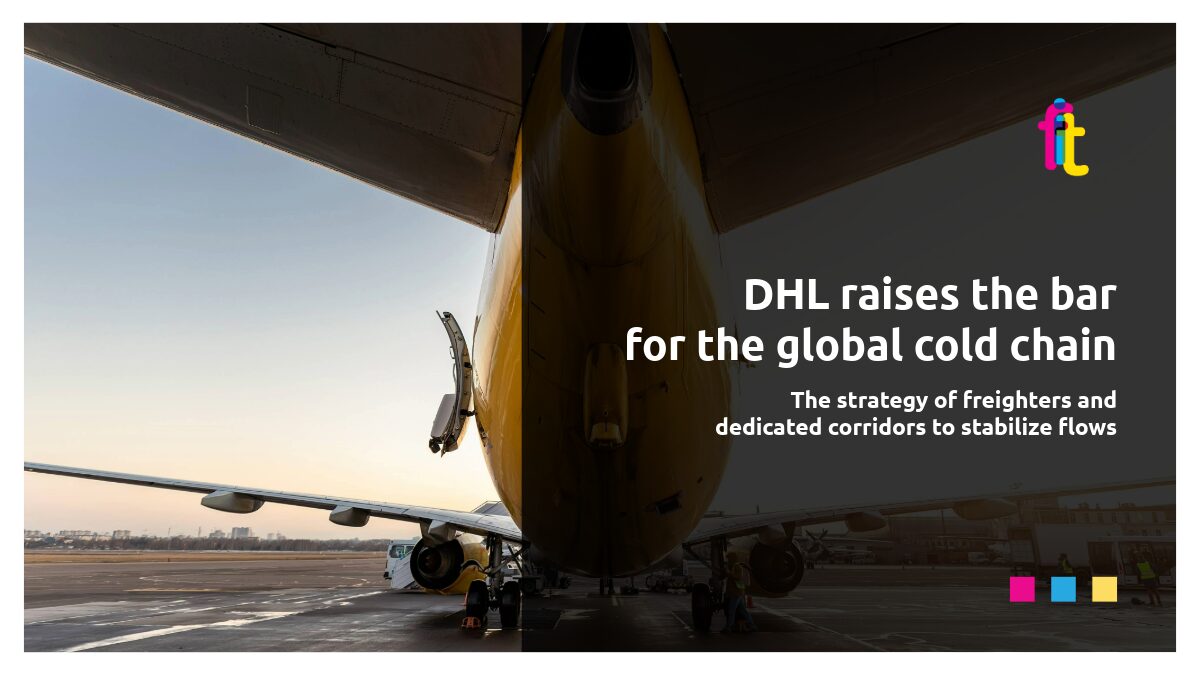
The strategy of freighters and dedicated corridors to stabilize flows
Temperature-controlled chains are undergoing a transformation.
Geopolitical volatility, fluctuations in commercial cargo capacity, and increasingly stringent quality and traceability requirements are prompting operators to rethink their networks and investments.
The DHL Group’s decision to launch a €2 billion plan through 2030 should be viewed in this context: reducing dependence on third parties and increasing control.
From “borrowed” capacity to a dedicated network
DHL is signaling a change in model: less reliance on passenger flight cargo space and more proprietary network, supported by its own fleet of Boeing 777 cargo planes.
The goal is to eliminate variables typical of the commercial market, such as cancellations and inconsistent handling standards, and maintain a more predictable chain.
The Brussels-Cincinnati corridor represents this logic: a direct connection with stable daily capacity between two key production clusters.
For a manager, the value is not the route itself, but the reduction in transfers and friction points that cause delays and discontinuity.
Brussels is also chosen as a gateway because of the speed of its customs corridors, which can clear validated cargo in less than 90 minutes.
Standards and visibility. The new competitive basis
The network described includes over 30 hubs and gateways that comply with Good Distribution Practice standards.
In Brussels, the operation is based on 45,000 square meters of dedicated areas, with management of different temperature ranges, from refrigerated to ultra-frozen environments.
Alongside the physical infrastructure, the importance of end-to-end visibility is growing: real-time tracking of temperature and location and automatic alerts in case of deviations. DHL also highlights an operational effect: a more controlled transit environment reduces the need for heavy passive packaging, with benefits in terms of costs and sustainability thanks to fewer disposable materials and lower shipment weights.
The roadmap includes expansion into India, Singapore, Japan, South Korea, and Brazil.
The message is clear: the global cold chain is moving towards more proprietary and measurable networks, where operational continuity depends on the ability to design control, standards, and predictability.
Sources:
https://www.asiacargonews.com/en/news/detail?id=11803#:~:text=from%20Huangpu%E2%80%91Wenchong-,DHL%20GROUP%20EXPANDS%20AIRFREIGHT%20COLD%20CHAIN%20NETWORK,deliver%20critical%20therapies%20to%20patients.%22