

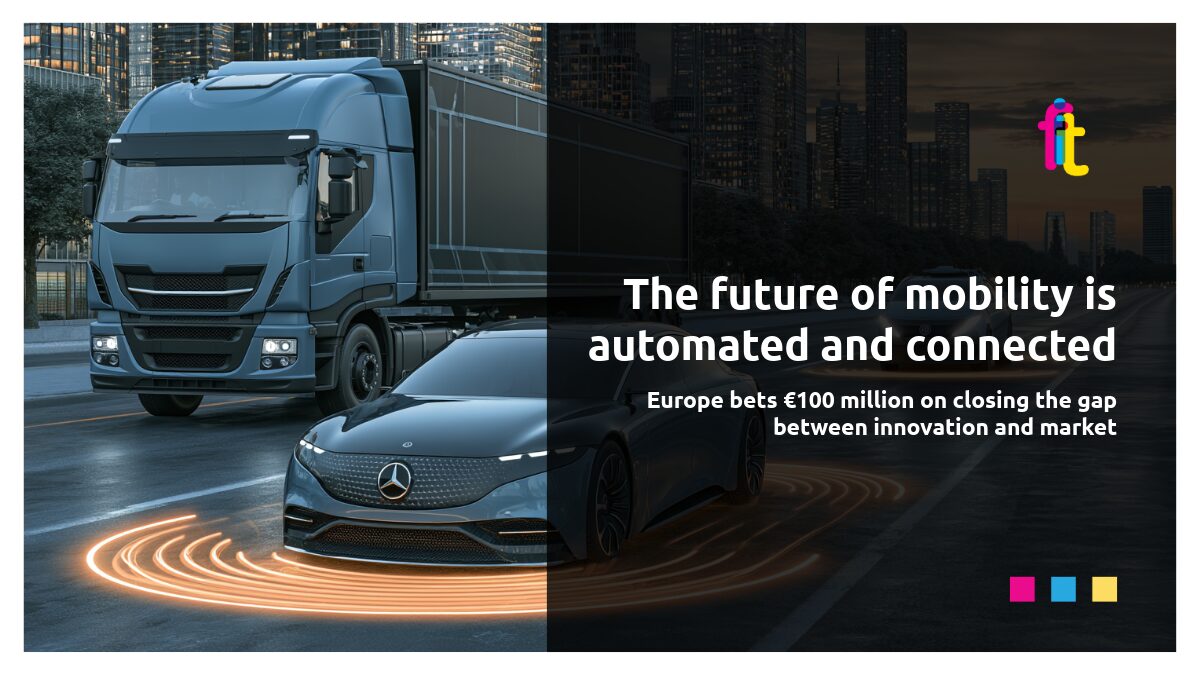
Europe bets €100 million on closing the gap between innovation and market
Europe produces world-class research on connected and automated mobility. Turning that research into vehicles on the road, services on the market, and measurable impact on emissions is another matter entirely. That gap between innovation capacity and commercial deployment is precisely what three new Horizon Europe topics aim to address.
The topics fall under the HORIZON-CL5-2026-10 call, scheduled to open on 4 June with a proposal deadline of 8 October 2026. They target cooperative, connected and automated mobility (CCAM) as part of the 2026-2027 work programme.
Why Europe is accelerating
Road transport is responsible for roughly a quarter of the EU’s total greenhouse gas emissions. Reaching climate neutrality by 2050 will require multiple technological levers working simultaneously: vehicle electrification, battery development, and the integration of connected and automated systems into real traffic conditions.
The European Commission and three key road transport partnerships (EGVIA for2Zero, the CCAM Association and Batteries Europe) have formalized this commitment through a Memorandum of Understanding aimed at positioning the EU as a leader in sustainable and smart mobility by 2035. The problem is that other regions are moving faster. Europe has strong academic foundations and significant patenting activity in CCAM, but lags behind China and the United States when it comes to deployment at scale.
This tension was a central theme at the Road Transport Research Conference 2026, held in Brussels in February. The event brought together the CCAM, 2Zero and Batt4EU communities and highlighted common obstacles: cost pressures, geopolitical uncertainty, and the EU’s persistent difficulty in extracting measurable value from its research results. One concrete response discussed was the creation of a cross-border test bed for integrating CCAM technologies into large fleets of heavy-duty vehicles across eight Member States, supported by regulatory sandboxes for harmonization between countries.
The flagship: €100 million for a single proposal
The centrepiece of the 2026 call is the CCAM flagship project (HORIZON-CL5-2026-10-D6-01). The scale is unprecedented for this sector: €100 million allocated to a single proposal, a major leap from the €15 to €20 million range typical of CCAM projects.
The objective is a large-scale pilot under real-world conditions, demonstrating CCAM solutions at technology readiness levels 7 and 8. Use cases are organized around three pillars: individual mobility across urban, suburban, motorway and rural environments; shared mobility and public transport with a focus on safety, accessibility and sustainable business models; and freight transport and logistics, with validation of end-to-end use cases and compatibility with multimodal applications.
This third pillar is particularly relevant for the logistics sector. Automated freight operations represent one of the areas where CCAM technologies could deliver the most tangible operational and environmental benefits. Validating these solutions at TRL 7-8 in real conditions would mark a significant step forward from the controlled-environment testing that has characterized most projects to date.
What comes next
For a project of this magnitude, technology alone will not determine success. Proposals must represent the full CCAM ecosystem: private developers, OEMs, public authorities, transport operators, municipalities, research institutions, SMEs, start-ups, and social sciences experts. Organizations interested in this call should connect with initiatives already underway through networks such as ECAVA, EARPA, ERTICO, the CCAM Partnership or the CCAMbassador project, where consortia are likely already taking shape.
Alongside the flagship, two additional topics address less mature areas. The first (HORIZON-CL5-2026-10-D6-02) focuses on geopolitical competition and socioeconomic resilience, benchmarking Europe’s position against other regions. The second (HORIZON-CL5-2026-10-D6-03) deals with generative AI applied to CCAM, prioritizing safe environmental perception and decision-making. Both will require multi-actor approaches and contributions from social sciences experts.
The message from Brussels is clear: Europe’s CCAM ecosystem has the knowledge. What it needs now is proof that the knowledge works at scale, in real traffic, with real operators.
Source: https://www.zabala.eu/news/europe-wants-to-bring-cooperative-connected-and-automated-mobility-to-market