
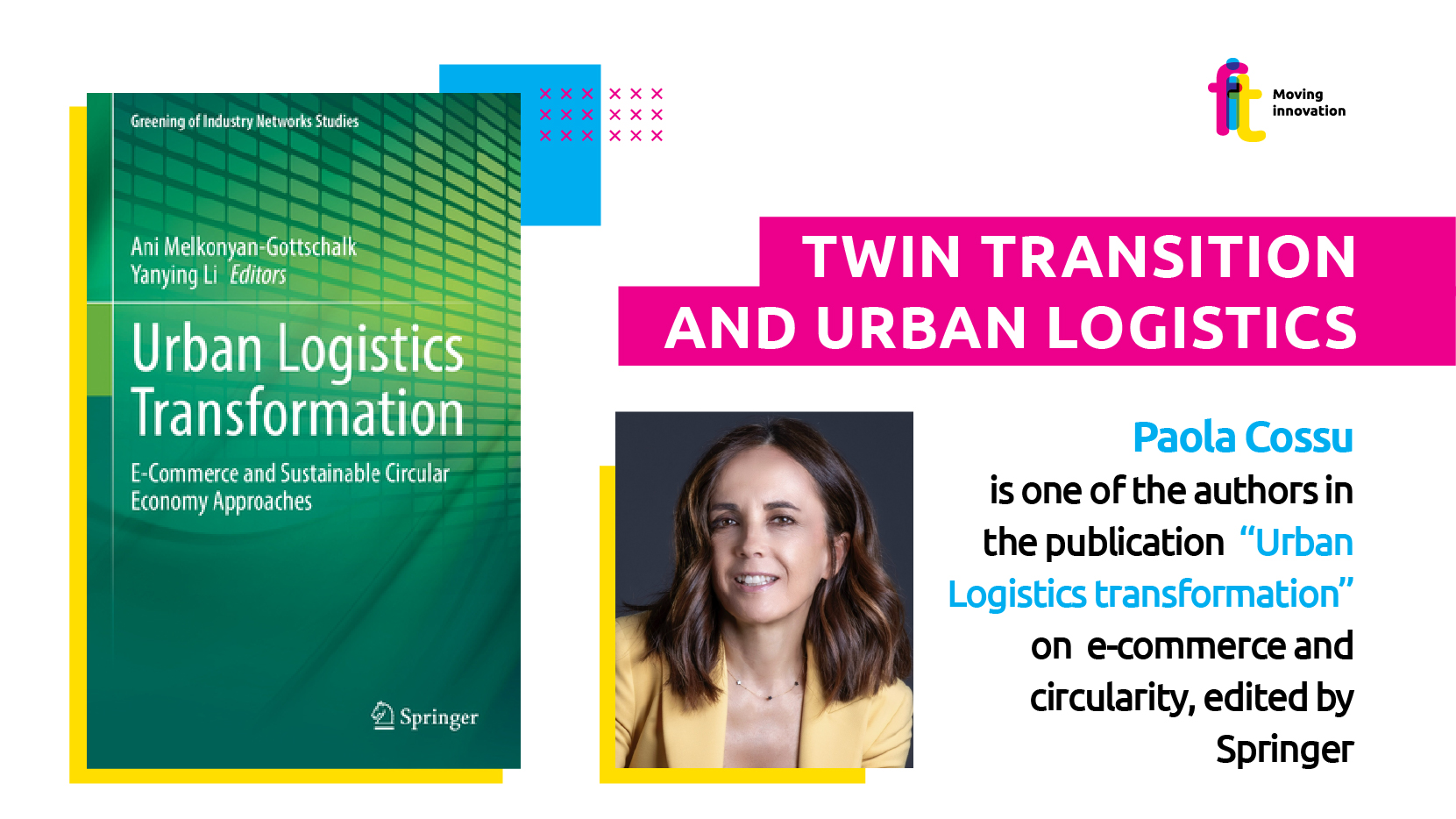
Paola Cossu is one of the authors of the recent Springer publication on “Urban Logistics Transformation” for climate-neutral cities
The book “Urban Logistics Transformation”, recently published by Springer Nature Switzerland and edited by Ani Melkonyan-Gottschalk and Yanying Li, brings together the most impactful advances in urban logistics research and innovation. It focuses on sustainable e-commerce, last-mile efficiency and competitiveness, and circularity.
Paola Cossu, CEO of FIT Consulting, authored the chapter “Mainstreaming the Twin Transition in urban logistics and planning for Climate Neutral Cities”, together with other distinguished global experts in the field.
When green and digital transitions align on the same path
European cities are grappling with a convergence of critical challenges: rising e-commerce pollutant emissions, escalating urban congestion, and fragmented supply chains. Tackling these issues in isolation is no longer a viable strategy.
This chapter explores how the green and digital transitions can mutually empower each other in urban logistics, accelerating progress towards climate neutrality by 2050. Drawing on insights from the World Economic Forum, it highlights that digital technologies, when widely adopted, could deliver up to 20% of the emission reductions necessary to achieve the net-zero goals.
However, these two transitions do not inherently align; digital infrastructures themselves have an environmental footprint, and without a cohesive, integrated approach, efforts in one area may hinder progress in the other. The chapter addresses this inherent tension with an operational framework designed to effectively balance and manage these dynamics.
Advanced solutions scale from EU-funded research and innovation projects
Chapter highlights advanced models successfully demonstrated in European cities through EU-funded projects such as DISCO, coordinated by FIT Consulting, and URBANE, where FIT is a key partner.
From the DISCO project, notable solutions include the Urban Access Control (UAC) in Ghent, which integrates urban vehicle access regulations into real-time logistics transport planning; the WareM&O platform in Thessaloniki, unlocking underused logistics hub capacity through blockchain-based smart contracts; and the Digital Twin in Copenhagen, which provides optimal logistics scenarios to support informed decision-making and measures in the Sustainable Urban Logistics Plan.
The URBANE project features an innovative Hub and Spoke model tested in Thessaloniki, a hybrid macro- and micro-consolidation system that combines Digital Twin and Agent-Based Modelling to deliver green last-mile solutions; the innovative model for lockers installed serving the Bologna net-zero nearby delivery areas, enhancing the proximity last mile and white label solutions and net-zero delivery. Both models evidence how collaboration among logistics operators can significantly enhance sustainability performance and optimize the use of urban space.
Some key recommendations for both operators and city authorities
The conclusions offer recommendations for both logistics operators and city authorities, addressing collaborative, circular and operational models, opportunities presented by multimodality, urban policies, infrastructure management, and enabling technologies.
The chapter highlights how AI-powered route optimization and collaborative urban freight data spaces can assist operators and city planners in making informed, real-time decisions. A strong emphasis is placed on circularity and inclusiveness, ensuring that small enterprises and local communities benefit from the transition rather than being left behind. The integration of smaller carriers and the establishment of open, balanced governance frameworks involving corporates, start-ups, technology providers, and public authorities are identified as essential for fostering a competitive and innovative market of green-digital solutions.
The core message is that each city must carve its unique path to circular climate neutrality through co-designed measures with local stakeholders. While the technology exists, without proper governance, high-quality data, and strong institutional capacity, there is a real risk that advanced tools may be adopted but fail to deliver lasting benefits to local communities and sector’s competitiveness.
The full volume is available on the Springer website: https://www.springerprofessional.de/en/urban-logistics-transformation/52267344