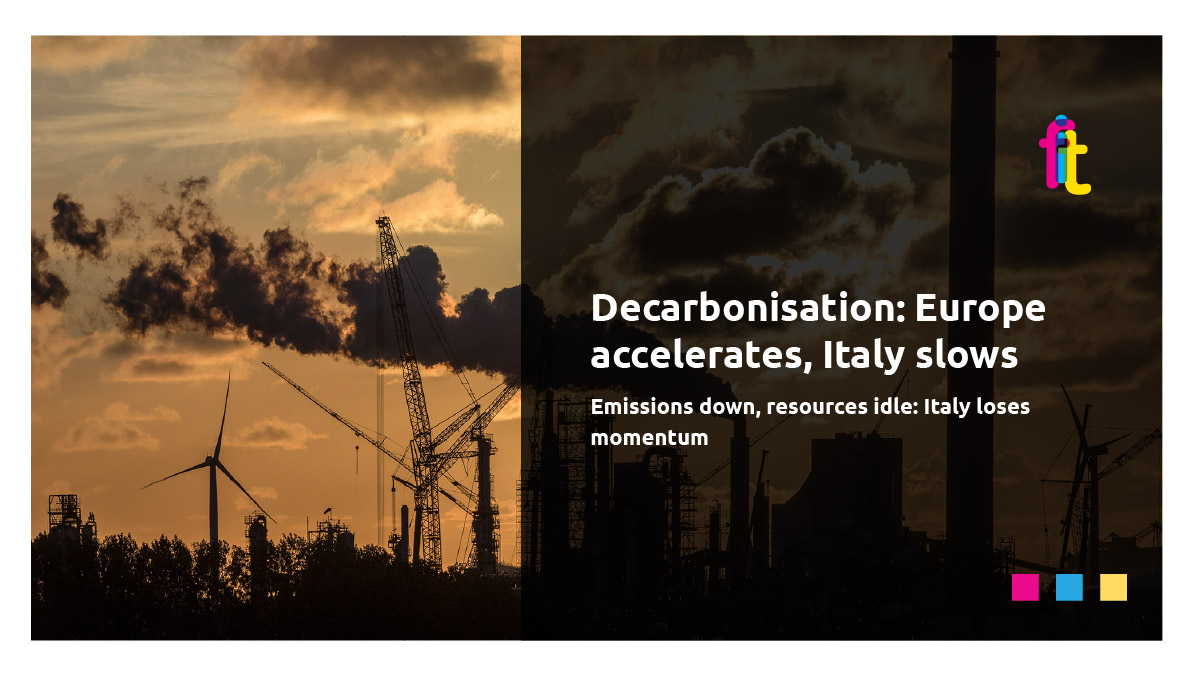
Decarbonisation: Europe accelerates, Italy slows down
Emissions down, resources idle: Italy loses momentum
Italy today finds itself facing a paradox. On the one hand, the latest data confirm a positive trend: since 1990, national emissions have dropped by 28.7 per cent. A reduction that reflects the combined effects of stricter environmental policies, technological innovation, the spread of renewables and industrial transformation. It is a concrete step forward, one that brings the country closer to the European climate objectives.
On the other hand, the National Recovery and Resilience Plan (PNRR) shows a very different picture. So far, only 34 per cent of the resources allocated have been disbursed, a delay that risks undermining the ability to turn ambitious plans for ecological and digital transition into reality.
The slowness of disbursements has tangible consequences. Projects already launched lose momentum, delaying their expected benefits and weakening their generative impact on local economies. Italy also risks damaging its international credibility, appearing as a country that announces ambitious strategies but struggles to match them with concrete implementation.
The uncertainty also weighs on the market. Companies ready to invest in clean technologies hesitate in the absence of reliable financial support, slowing down innovation and competitiveness. And the gap between regions widens: territories with less administrative capacity risk falling further behind, unable to intercept the resources available and thus accentuating existing disparities.
What is needed now is a serious simplification of bureaucratic procedures to accelerate the release of PNRR funds. Stronger public–private partnerships must be promoted, making the most of technical expertise and local networks to turn resources into real projects. Transparent and rigorous monitoring is essential to prevent waste, corruption and unproductive delays. Finally, technical and advisory support should be provided to local authorities and operators who may have solid ideas but lack the skills required to access funds effectively.