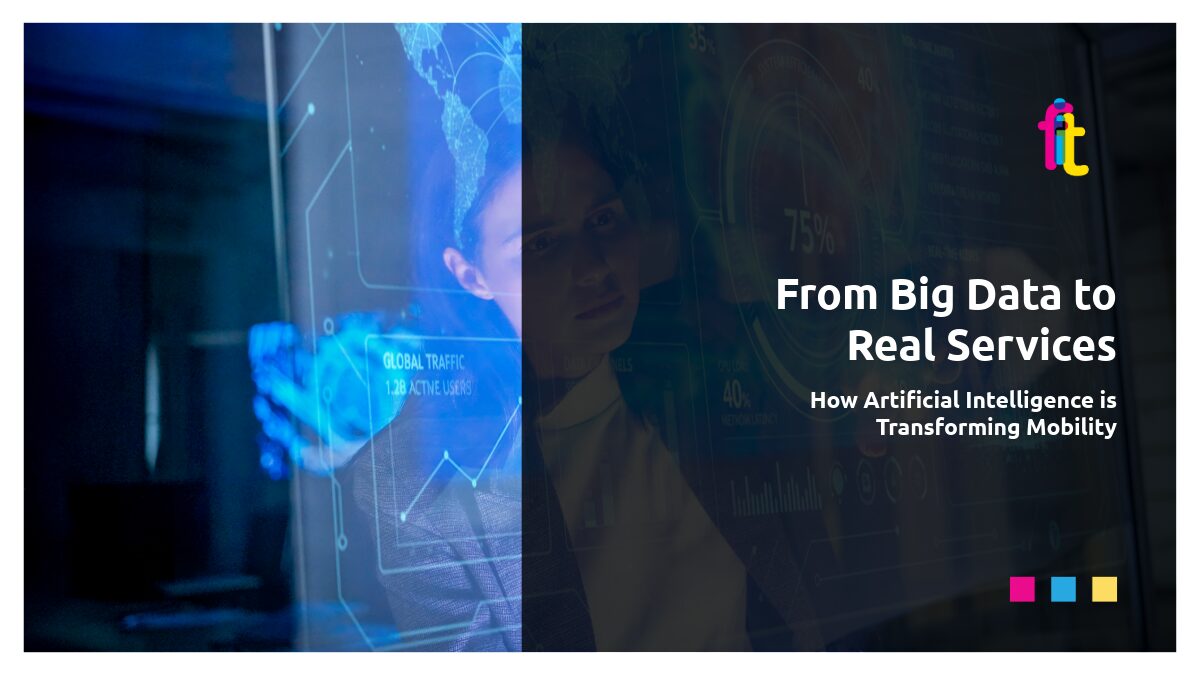
From Big Data to Real Services
How Artificial Intelligence is Transforming Mobility
The digital transition has provided public administrations and mobility managers with an unprecedented amount of information. However, the real leap forward does not lie in merely accumulating data, but in transforming it into efficient, predictive, and user-centric mobility services.
This was the central theme explored by Pierluigi Coppola (Politecnico di Milano) during the Data Mobility Summit 2025. His presentation clearly highlighted how new technologies are retiring traditional methods of demand analysis, opening up entirely new scenarios for urban planning.
Beyond Questionnaires: Digital Travel Diaries
For decades, transport planning has relied on questionnaires and sample surveys: tools that are slow to process, expensive, and often prone to inaccuracies. Today, the paradigm has shifted. The use of smart apps and digital travel diaries allows for the continuous and accurate tracking of people’s real-world behavior.
Thanks to the application of Supervised Learning and Artificial Intelligence, it is now possible to analyze this massive amount of raw data to map the origins, destinations, and duration of trips with surgical precision, overcoming the limitations of old static matrices.
The Quantum Leap: The “Activity-Based” Approach
Knowing where a vehicle travels from and to is no longer enough; to plan effective services, it is crucial to understand why people move.

New predictive models adopt an activity-based approach: mobility is analyzed as a direct consequence of daily activities (work, study, errands). This level of detail makes it possible to simulate complex scenarios with extraordinary reliability, predicting exactly how traffic flows will change in response to new urban policies, such as road closures, fare adjustments, or the introduction of new shared mobility services.
Real-Time Data and “Nudging”
Advanced Big Data processing is not just for long-term planning; it paves the way for dynamic and immediate interaction with the user. The true frontier is the combination of real-time data and nudging techniques (a concept borrowed from behavioral economics).
By understanding travelers’ habits, mobility apps can proactively guide choices toward more sustainable and efficient options. For example, they might suggest that a commuter leave 15 minutes early to avoid overcrowding, or propose a carpooling alternative when a train is delayed.
For public administrations and transport operators, governing these data-driven processes is the only way to optimize operational costs, improve the user experience, and concretely drive the ecological transition.